Ecommerce guide
How to Start a Business in the Philippines: The Complete 2026 Registration Guide for Online Sellers
Most Philippine online sellers start the wrong way round. Since RA 11967 took full effect on 20 June 2025, registration is the thing standing between you and a working payout account.

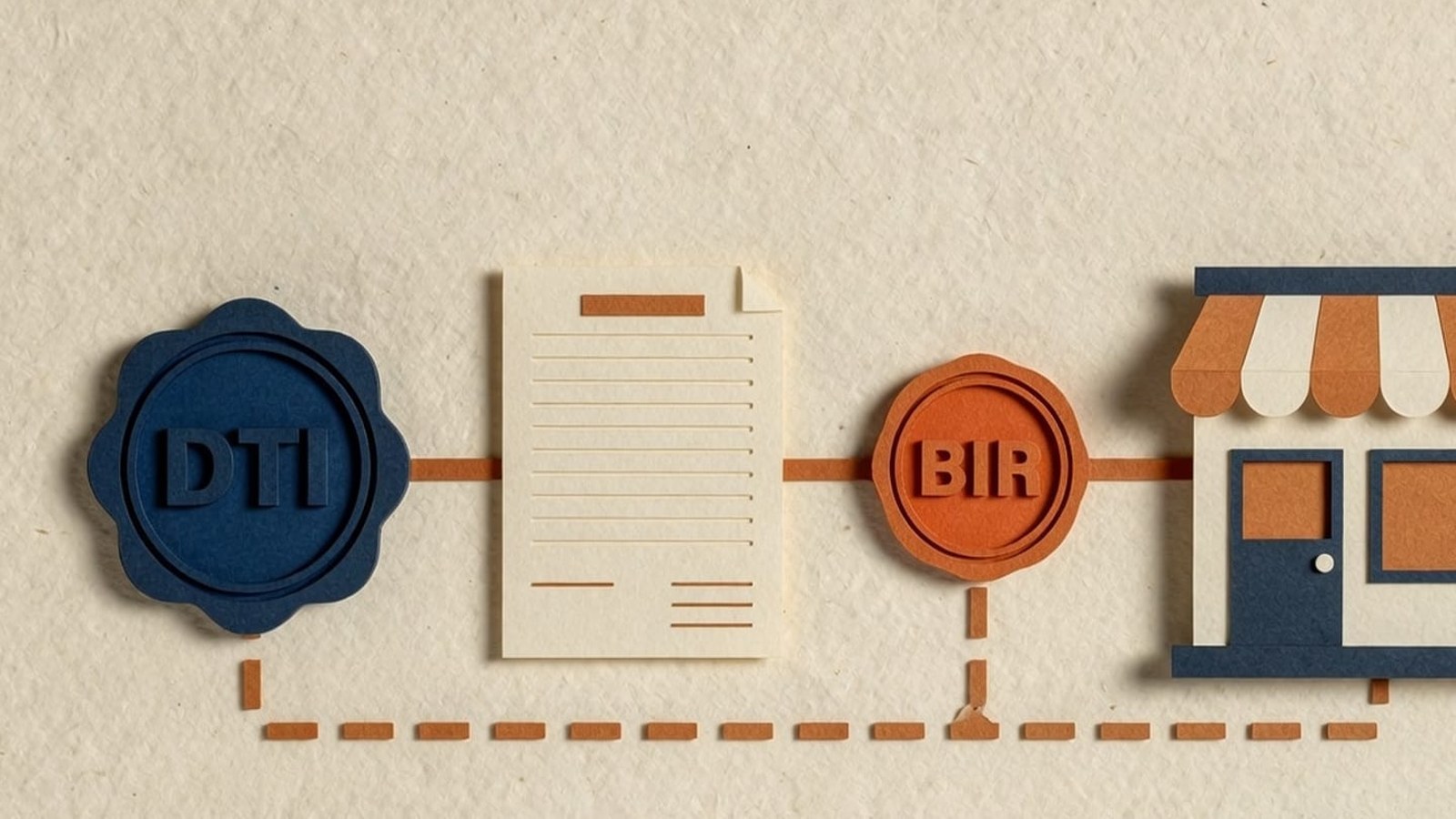
Register before you take the first paid order. Since the Internet Transactions Act (Republic Act No. 11967) took full effect on 20 June 2025, marketplaces are required to verify sellers against government registration before treating them as a proper business account. For a solo online seller the process is short, cheap and mostly done online: DTI or SEC, barangay, Mayor’s Permit, BIR, then the marketplace layer. A diligent sole proprietor can clear it in 2–4 weeks, for roughly ₱2,000–₱5,000 lean or ₱8,000–₱18,000 in a typical city.
Most Philippine online sellers start the wrong way round. They open a Shopee shop on a Sunday afternoon, list a few products, get a sale, and only think about DTI or BIR months later — usually when a marketplace freezes a payout pending “seller verification.” That order used to be low-risk. It isn’t any more.
The Bureau of Internal Revenue has followed with its own display requirement. Registration is no longer a formality you get around to. It’s the thing standing between you and a working payout account. This guide walks through it in order, with the current 2026 fees, timelines and the specific extra layer that applies if you’re selling through Shopee, Lazada, TikTok Shop or your own store.
Registration is no longer a formality you get around to. It’s the thing standing between you and a working payout account.
The walk, in order
Structure first. Then DTI or SEC, barangay, Mayor’s Permit, BIR, then the marketplace layer. Skip ahead only if you already know your structure.
- 01
Decide the structure
Sole prop via DTI for most first-time sellers. OPC or corporation via SEC if liability, a co-founder or capital is the point.
- 02
DTI or SEC
Business name on BNRS, or eSPARC if you’re incorporating. Pay within 7 days or the DTI application is abandoned.
- 03
Barangay clearance
The barangay where the business actually sits — including a home. ₱100–₱1,000, same day to a few days.
- 04
Mayor’s Permit
The permit that authorises you to operate, bedroom or not. ₱1,500–₱8,000 all-in. Expires every 31 December.
- 05
BIR (1901 / 1903)
Invoices, not Official Receipts. Books of accounts. Elect 8% or stay on 3% if you’re under ₱3 million. The ₱500 ARF is gone.
- 06
Marketplace layer
RA 11967 display rules, BIR Registration Seal Badge, DTI/SEC + Mayor’s + BIR PDFs for verification, 0.5% withholding.
Step 0 — Decide your structure before you register anything
Two paths, and most first-time sellers only need the first one.
Sole proprietorship — you register a business name with the DTI, trade under it, and you and the business are legally the same person. Cheapest, fastest, no separate legal entity, and the default choice for a solo seller or small team. You carry unlimited personal liability, which matters less at ₱30,000 a month and more once you’re carrying inventory, staff and supplier contracts.
One Person Corporation (OPC) or full corporation/partnership — you register with the Securities and Exchange Commission (SEC) instead. This creates a separate legal entity that owns the business, protecting your personal assets from business liabilities. It suits sellers bringing in a co-founder, planning to raise capital, or scaling past the point where personal liability is an acceptable risk. It costs more and takes longer, and there’s no shortcut around that trade-off.
If you’re reading this because you want to start selling this month, register as a sole proprietorship and revisit the OPC question once revenue and risk justify it.
Step 1 — Register your business name with the DTI (sole proprietorship)
Business Name registration is handled entirely online through the DTI’s Business Name Registration System (BNRS), at bnrs.dti.gov.ph. If you’re trading under anything other than your own legal name — which is almost every seller — you need this first.
What you need: one valid government-issued ID (passport, driver’s licence, UMID, PhilID), an active email address, your proposed business name, proof of address, and your TIN if you already have one.
What it costs, by territorial scope — this is the geographic reach of the name, not a limit on where you can actually sell:
| Scope | Fee | Plus DST |
|---|---|---|
| Barangay | ₱200 | +₱30 |
| City/Municipality | ₱500 | +₱30 |
| Regional | ₱1,000 | +₱30 |
| National | ₱2,000 | +₱30 |
Most solo online sellers register at Barangay or City scope — national scope is overkill until you’re operating branches or a genuine nationwide brand presence. You must pay within 7 calendar days of applying, or the application is automatically abandoned.
Timeline: the whole thing is designed to finish in one sitting online — figure under an hour if your documents are ready. Your certificate is valid for 5 years. Renewal opens 180 days before expiry; there’s a 90-day grace window after expiry before a 50% late surcharge applies, and the name becomes available to others if you miss that too.
One thing that trips people up: you cannot use “company,” “corporation,” “incorporated” or “cooperative” in a DTI-registered name — those words are reserved for SEC- and CDA-registered entities. If your proposed name is a duplicate, contains a trademarked term, or reads as purely generic, it will be rejected and you’ll need to resubmit.
Step 1 (alternative) — Register with the SEC if you’re incorporating
If you decided in Step 0 that you want an OPC or full corporation, skip DTI and register with the SEC instead, through the eSPARC portal (esparc.sec.gov.ph). You’ll first need a credentialed eSECURE account (₱400, valid two years) before you can file.
For an OPC specifically: you need a single stockholder (a natural person, trust or estate), a nominee and alternate nominee with signed written consent (they step in if you’re incapacitated), and a company name ending in “OPC.” There’s no minimum capital requirement unless a specific law says otherwise. Within 15 days of getting your Certificate of Incorporation, you must appoint a treasurer and corporate secretary — the stockholder can hold the treasurer role but can’t also be corporate secretary.
What it costs, approximately: a filing fee of 1/5 of 1% of your capital stock or subscription price (minimum ₱2,000), a Legal Research Fee of about 1% of the filing fee, name verification (₱100) and reservation (₱100 per 30 days), plus the eSECURE credentialing fee. Realistically budget ₱3,000–₱8,000+ depending on declared capital — this scales up, unlike the flat DTI fee.
Timeline: typically a few days to two weeks through eSPARC, assuming your nominee documentation is in order. SEC MC No. 10, Series of 2026 tightened OPC reportorial obligations, including annual financial statements due within 120 days of your fiscal year-end — build that into your calendar from day one.
Step 2 — Get your barangay clearance
Whichever path you took in Step 1, the next stop is the barangay where your business is physically located (including a home-based operation).
What you need: your DTI certificate or SEC registration, a valid ID, and proof of your business location — a lease contract, or a sketch/photo if you’re operating from home.
What it costs: ₱100 to ₱1,000, set by local ordinance and scaled to your declared business size — this varies genuinely barangay to barangay, so don’t assume the fee from one LGU applies to your own.
Timeline: same day to a few days.
Step 3 — Apply for your Mayor’s/Business Permit
This is the permit that actually authorises you to operate, and it’s the one most online sellers underestimate, because “I work from my bedroom” feels like it shouldn’t require a Mayor’s Permit. Legally, it still does.
What you need: DTI or SEC certificate, barangay clearance, community tax certificate (cedula), and — depending on your LGU and business type — fire safety and sanitary clearances.
What it costs: genuinely LGU-dependent. Budget ₱1,500–₱8,000 all-in including fire and sanitary fees; costs run higher in Metro Manila cities and scale with your declared capital.
Timeline: under Republic Act No. 11032 (the Ease of Doing Business Act), a Mayor’s Permit is a “complex” transaction with a statutory 7-working-day ceiling, processed through the LGU’s Business One-Stop-Shop (BOSS). In practice this ranges from 3 days in LGUs with a digitised BOSS to a few weeks in less automated ones. The permit is valid for one calendar year, expires every 31 December, and renews between 1–20 January — mark that window, because renewal penalties stack fast.
Step 4 — Register with the BIR
This is the step with the most moving parts, and the one that actually determines whether marketplaces will treat you as a real seller.
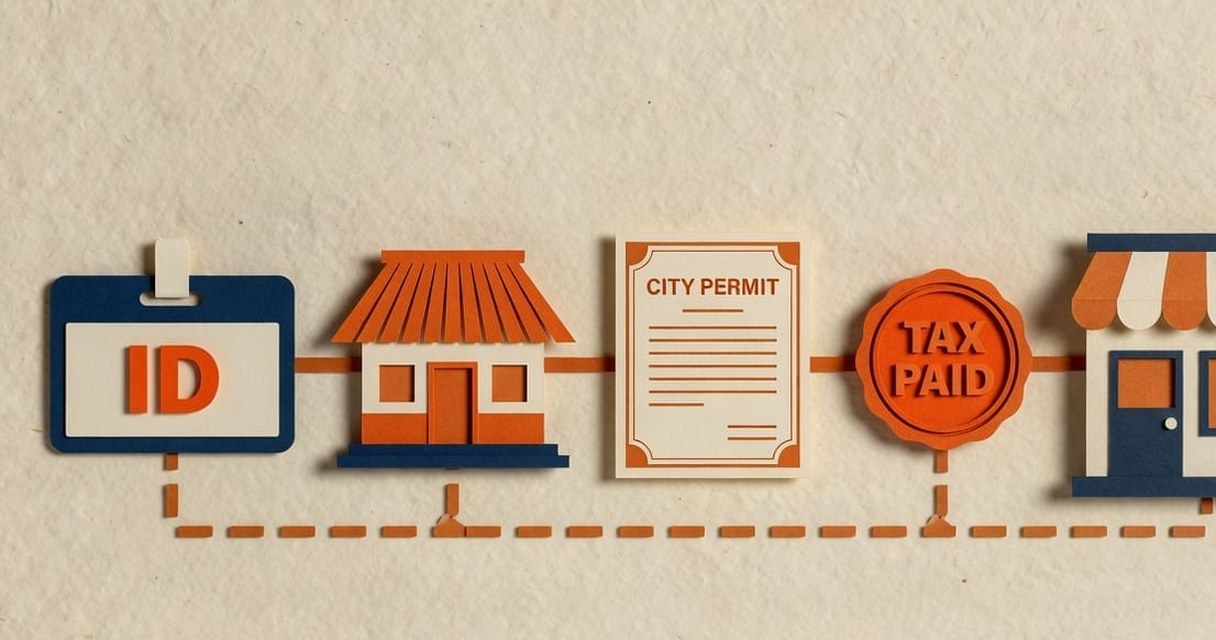
The form: BIR Form 1901 if you’re an individual/sole proprietor, or Form 1903 if you registered a corporation, OPC or partnership. You can file at your Revenue District Office’s New Business Registration Counter, online through ORUS (orus.bir.gov.ph), or via the NewBizReg Portal, TRRA Portal or Philippine Business Hub.
When to register: “on or before commencement of business, or before paying any tax due or filing a return — whichever comes first,” per the BIR’s own guidance. In practice: before your first sale, not after.
What you need: the completed form, a valid government ID, your DTI certificate (or SEC certificate plus Articles of Incorporation for a corp/OPC), and either a sample of your own invoices with Form 1906 attached, or proof you’re buying BIR-printed invoices at the RDO.
Choosing your tax type — this is where sellers waste money
- Percentage tax (non-VAT): 3% of quarterly gross sales, filed via Form 2551Q, for anyone under the ₱3 million annual threshold who doesn’t elect the option below.
- 8% flat income tax: 8% of gross sales/receipts over ₱250,000, in lieu of both percentage tax and graduated income tax. You elect this on Form 1901 at registration, or on your first quarterly return of the year — miss that window and you default to graduated rates.
- VAT: mandatory once annual gross sales/receipts exceed ₱3 million, at 12%.
Pick deliberately. Most solo sellers under ₱3 million a year are better off on the 8% option once their expenses are low relative to revenue — but run the actual numbers rather than defaulting to whichever box looks familiar.
Invoices, not Official Receipts: the Ease of Paying Taxes Act unified “Official Receipt” and “Sales Invoice” into a single “Invoice” (effective 27 April 2024). Any sale of ₱500 or more needs one; smaller transactions can be aggregated into a single invoice at day’s end. If you’re VAT-registered, you invoice regardless of amount. Old official receipt stock can still be used until it runs out — there’s no forced cutover date.
Books of accounts: register these before the deadline for your first quarterly or annual income tax return, whichever comes earlier. This is now done through ORUS, which issues a QR-code stamp instead of the old manual stamping process. If your annual sales exceed ₱3 million, your books need a yearly independent CPA audit.
Step 5 — What online sellers specifically need on top of all that
Registering the business is the general-purpose part. Selling through a marketplace or your own store adds a layer specific to ecommerce.

The Internet Transactions Act (RA 11967): in full effect since 20 June 2025. It requires you to display your complete business details (name, physical address, contact info), the country or place of origin of your goods, accurate pricing and product descriptions, basic data-privacy practice, and a way for customers to raise a complaint. It applies even to foreign sellers and platforms targeting Philippine buyers.
Marketplace verification: Shopee, Lazada and TikTok Shop all ask for your DTI or SEC certificate, Mayor’s Permit and BIR Certificate of Registration to activate full/registered-business seller status — TikTok Shop in particular won’t approve a seller account without them. Have PDFs of all three ready before you apply, not scrambling for them when a verification prompt appears mid-payout-cycle.
The BIR Registration Seal Badge (RMC No. 38-2026): issued in 2026, this is the one to take seriously. It requires online sellers, freelancers, professionals, influencers and other digital-platform earners to generate a Registration Seal Badge through ORUS and display it on their website, storefront or social media business page — typically in an “About Us” or equivalent section. It’s free to generate (aside from the ₱30 DST if unpaid), carries a QR code for verification, and deliberately replaces posting your full Certificate of Registration, which exposed your TIN and address.
The DTI E-Commerce Trustmark: don’t confuse this with the badge above. The Trustmark is a separate DTI-issued digital badge recognised under RA 11967. The law’s text frames it as required for online merchants and platforms, but the DTI has kept actual enrolment voluntary through 31 December 2026, with a review due at year-end to decide what happens next. If you apply anyway — and it’s a reasonable trust signal for a growing store — fees are tiered by asset size: ₱130 all-in for micro businesses (assets ≤₱3 million), ₱630 for small (₱3,000,001–15 million), ₱1,130 for medium (above ₱15 million). Processing takes 7 working days once your documents are complete.
Withholding tax on marketplace payouts: this has changed more than once, so verify the current rate before you rely on it. As of the BIR’s May 2026 update (RMC No. 55-2026), e-marketplaces and digital financial services providers withhold 0.5% of your gross remittances, and you’re exempt if your cumulative remittances for the year don’t exceed ₱500,000. It’s a creditable tax — you claim it back against your income tax due, not a straight loss. Don’t be surprised by a payout that’s slightly lower than your sales total; reconcile it rather than assume an error.
What it actually costs — a realistic 2026 budget
| Item | Typical range |
|---|---|
| DTI Business Name (barangay/city scope) | ₱230–₱630 |
| Barangay Clearance | ₱100–₱1,000 |
| Mayor’s/Business Permit + fire/sanitary | ₱1,500–₱8,000 |
| BIR (DST + invoices) | ₱30–₱3,000 |
| Manual books of accounts | ₱300–₱1,500 |
| Minimum stack, lean/home-based | ~₱2,000–₱5,000 |
| Typical city-based small store | ~₱8,000–₱18,000 |
| DTI Trustmark (optional) | ₱130–₱1,130 |
| SEC OPC instead of DTI (optional) | ₱3,000–₱8,000+ |
What it actually takes — a realistic timeline
DTI: same session, online. Barangay clearance: same day to a few days. Mayor’s Permit: 7 working days by law, 3 days to a few weeks in practice depending on the LGU. BIR: a few days once your documents are complete. SEC/OPC, if you went that route: a few days to two weeks. Trustmark, if you apply: 7 working days.
Put together, a diligent solo seller can clear the sole-proprietorship route in 2–4 weeks. Incorporating adds another one to two weeks on top of that.
Common mistakes that cost sellers time and money
- Selling for months before registering, then hitting a marketplace verification hold right when sales are picking up.
- DTI name rejected for duplication, a reserved corporate word, or a name that reads as purely generic.
- Assuming no sales means no filing obligation — once you’re registered, you owe a return for every tax type on your Certificate of Registration, even a zero return.
- Using bookstore order slips instead of an ATP-approved or BIR-printed invoice — this is a real violation, not a technicality.
- Missing the 8% tax election window, then defaulting to graduated rates you didn’t want.
- Never registering books of accounts, which is usually the first thing a BIR examiner asks for.
- Confusing the Trustmark with the Registration Seal Badge — one is optional reputation building, the other is closer to a compliance requirement.
- Skipping employer registration (SSS, PhilHealth, Pag-IBIG) the moment you hire your first virtual assistant or packer.
If you’re still validating the opportunity, read why e-commerce keeps growing here. When you’re ready to go deeper than DIY, our Shopify Partner team can take the build off your plate — or start with the rest of our ecommerce guides if you’re still in research mode. The Shopify Philippines setup guide walks the owned-store path once the certificates are in the drawer.
FAQ
Common questions
Do I need to register with DTI before selling on Shopee or Lazada?
Yes. You’re legally required to register regardless of platform, and in practice, Shopee, Lazada and TikTok Shop all now ask for DTI (or SEC) and BIR certificates to activate full seller status, especially once you’re doing meaningful volume.
What’s the difference between DTI and SEC registration?
DTI registers a business name for a sole proprietorship — you and the business are the same legal person. SEC registers a separate legal entity — a corporation, OPC or partnership — which shields your personal assets from business liability but costs more and takes longer to set up and maintain.
How much does it cost to register a small online business in the Philippines?
₱2,000–₱5,000 for a lean, home-based sole proprietorship (DTI, barangay, Mayor’s Permit and BIR combined). City-based stores with higher declared capital typically land between ₱8,000 and ₱18,000.
Do online sellers pay withholding tax on marketplace sales?
Yes, if you sell through a marketplace or digital payment provider. As of the BIR’s May 2026 update (RMC No. 55-2026), platforms withhold 0.5% of your gross remittances, with an exemption if your cumulative annual remittances stay at or below ₱500,000. It’s creditable against your income tax, not an extra cost.
Is the DTI Trustmark mandatory in 2026?
Not in practice. The underlying law frames it as required, but the DTI has kept enrolment voluntary through 31 December 2026, pending a review of whether to make it compulsory afterwards. It’s still a reasonable trust signal to have if you’re building a repeat-customer brand.
Keep reading
Related guides
Done-for-you
Ecommerce Philippines
Registration is the unglamorous half. The other half is a store and channel mix that turns registered status into revenue — Shopify, Shopee, Lazada, TikTok Shop, payments Filipinos actually use. That’s the work we run for ecommerce brands in the Philippines.